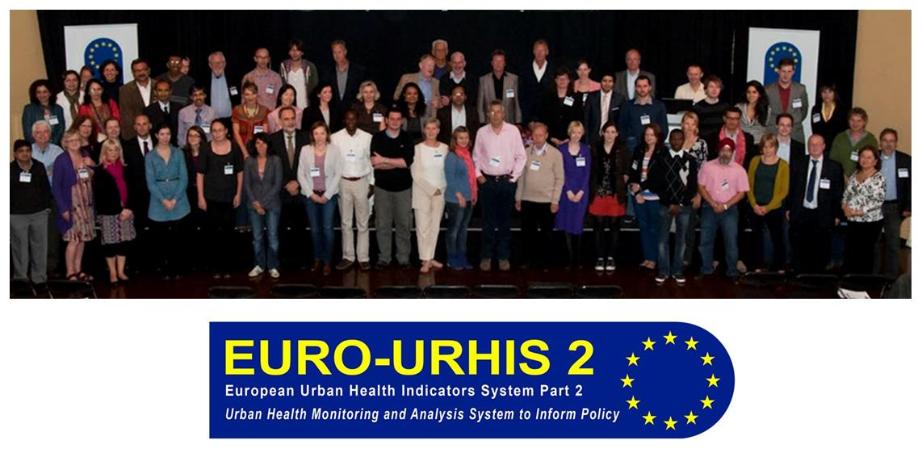
EURO-URHIS 2 - European Urban Health Indicators System Part 2
Urban Health Monitoring and Analysis System to Inform Policy
The EURO-URHIS 2 consortium welcome you to our website where you will find information about our project, urban health matters and related projects. The EURO-URHIS 2 project received funding from the European Union's Seventh Framework Programme (FP7/2007-2013) under grant agreement number 223711. The EURO-URHIS 1 project received funding from DG SANCO under grant agreement number 2005119, 2006-2008.
The European Urban Health Indicators System Part 2 (EURO-URHIS 2) project commenced on 1st January 2009. The project followed on from EURO-URHIS, which developed a network of 60 urban areas across Europe. The EURO-URHIS initiative sought to find the availability of many health indicators across Europe, and to describe some features of health that, whilst not specific only to urban situations, have a major impact on the health of urban residents.
The EURO-URHIS 2 project has resulted in the largest set of individual level Urban Health Indicators in the world. These indicators have been analysed for the urban areas involved in the project and Health Profiles have been created. Please follow the relevant links to find download the Health Profiles and view the interactive results at our results website.
Dr Arpana Verma, principal investigator and coordinator of EURO-URHIS 2 says "2008 was a momentous year, it was when, globally, more people lived in cities than in rural areas. The health needs of urban dwellers will now deal with the majority of the World’s population. Cities are where inequalities are most apparent, pollution is rising, sustainability is a priority, access to healthy lifestyles is difficult, movement in and out is rapid and ever changing, infectious diseases spread fast and health policy involves many actors. We are very grateful to DG SANCO and DG Research of the EU Commission for funding our two projects. Our immense thanks and gratitude also go to all those individuals who have helped us in both projects.”
The EU Public Health Programme work plan 2005 identified the development of an urban health indicator system as an essential part of a comprehensive and integrated EU health information and knowledge system. Based on this, EURO-URHIS 2 is developing, testing and validating a set of comparable urban health indicators (building upon the work already completed by EURO-URHIS 1 and other related projects) in over 40 cities across the European Union and beyond.
For more information, why not follow us on Twitter, join our LinkedIn group, register to receive our regular newsletters above, or contact us at eurourhis2@manchester.ac.uk
Arpana Verma is head of the Manchester Urban Collaboration oh Health (MUCH) which is part of the Faculty of Medical and Human Sciences (FMHS) in the Manchester Academic Health Science Centre (MAHSC).